











Cloud ERP has momentum. SAP’s latest quarterly results showed Cloud ERP Suite revenue up 29% year on year (28% at constant currencies), reaching €5.92 billion in the quarter, compared with €4.59 billion a year earlier. Total quarterly revenue passed €10 billion for the first time in SAP’s history, and Cloud ERP Suite now makes up 89% of SAP’s total cloud revenue.
Analysts read this as a sign that customers continue to migrate core financial, HR and operational systems to the cloud. For any business weighing its own next step, the market signal is clear: many organizations are making this move.
But market momentum is not a business case. The fact that others are investing tells you very little about whether your own investment will pay off. To answer that, the conversation has to become much more specific.
From market momentum to daily decisions
The most useful way to start an ERP conversation is not with features or platforms. It is with the decisions your people make every day, and whether the new system will help them make those decisions better.
Will finance close the month faster? Month-end close is one of the clearest tests of whether data flows cleanly through a business. If reconciliations, accruals and intercompany adjustments still depend on spreadsheets and manual checks, the close will stay slow no matter how modern the system is.
Will purchasing have a reliable view of demand before committing cash? Buying decisions made on stale or incomplete demand data lead to excess inventory in some places and shortages in others. A connected ERP should give buyers a view of demand they can trust before money leaves the business.
Will sales be able to promise delivery dates that operations can actually meet? Few things damage customer trust faster than a missed commitment. When sales can see real capacity and inventory before promising a date, promises become reliable rather than hopeful.
These questions are good starting points because they connect the system directly to daily decisions. They also make it obvious who cares about the answer.
Three things to agree before approving a project
Before approving an ERP project, we believe three things should be agreed and written down.
A baseline for current performance. You cannot prove improvement without knowing where you started. How many days does the close take today? How often are delivery promises missed? How long does it take to produce the reports leadership relies on? A baseline turns opinions about the current state into facts.
A business owner for each intended improvement. Technology teams can deliver a system, but they cannot own a faster close or more reliable delivery promises. Each intended improvement needs a named owner in the business who is accountable for the outcome and who has the authority to change how work is done, not just which software is used.
A date to review the result after go-live. Go-live is not the finish line. Setting a review date, often three to six months after launch, creates a moment where the business checks whether the promised improvements actually arrived. It also signals from day one that the project will be judged on results, not just delivery.
Make vague goals specific
Many ERP business cases include goals like “improve reporting” or “increase visibility.” These sound reasonable, but they are almost impossible to measure, and so they are almost impossible to achieve in any meaningful sense.
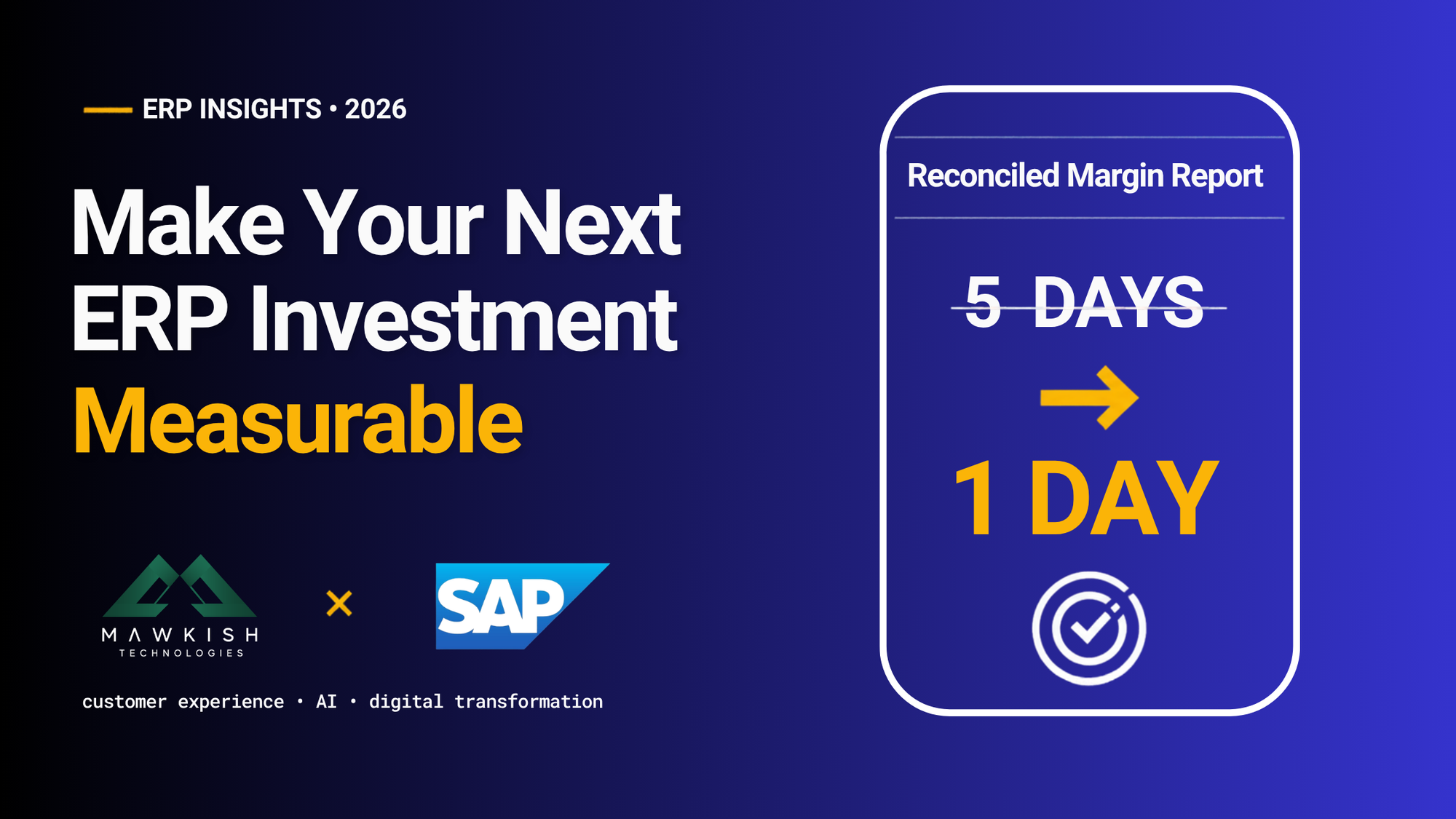
Compare that with this: reduce the time needed to produce a reconciled margin report from five days to one.
That version tells everyone exactly what success looks like. It points to the data that needs to be connected, the reconciliation steps that need to be automated, and the people whose work will change. It gives finance a clear target and gives the implementation team a clear test. And when the review date arrives, there is no debate about whether the goal was met.
The same discipline works across the business. “Better inventory management” becomes a specific reduction in stock-outs or excess stock. “Improved customer service” becomes a measurable increase in orders delivered on the date promised.
Measurement helps you prioritise scope
This approach does more than make results easier to judge. It also helps teams decide what to build first.
ERP implementations rarely fail for lack of ambition. More often they struggle because scope keeps growing, every department adds requirements, and the project tries to do everything at once. When each part of the scope is tied to a measurable improvement with a named owner, prioritisation becomes much easier. Work that moves an agreed metric goes to the front of the line. Work that cannot be linked to any measurable outcome deserves a harder look.
It also gives everyone involved a shared reason for the change. Change is difficult, and people adopt new ways of working more readily when they understand what the change is for and can see progress against a goal they recognise.
A practical way to start
If you are considering an ERP investment, start small. Choose two or three of the decisions that matter most to your business. Measure how long they take today, or how often they go wrong. Name the person who would own each improvement. Then agree what “better” would look like, in numbers, and when you will check.
That short exercise will tell you a great deal about where an ERP investment would add the most value, and it will give your business case a foundation that finance, operations and technology teams can all stand behind.
The question worth asking
Cloud ERP is growing quickly, and for good reason. But the value of any ERP investment is only as real as the improvements it delivers inside your business.
So here is the question we would put to any leadership team considering its next step: which measurable improvement would justify your next ERP investment?
At Mawkish Technologies, we help organizations turn ERP ambitions into measurable business outcomes, from defining baselines and success measures to designing implementations that deliver against them. Get in touch to talk about what a measurable ERP investment could look like for your business.