










Every manufacturer knows the moment. A supplier email lands, a tracking update changes, or a planner spots a gap in the schedule: a critical raw material is going to arrive late. The alert itself is rarely the problem. The problem is what happens next, and how long it takes.
SAP’s latest supply chain commentary got us thinking about a deceptively simple question: how quickly can your business turn a disruption alert into a coordinated decision? We think the answer is one of the most useful ways to judge whether your ERP, data and automation investments are paying off.
What SAP is signaling
At SAP Connect on October 6, SAP announced a partnership that places Moody’s supplier risk data inside SAP Ariba, along with new Joule Agents for its supply chain assistants, with both listed for general availability in Q4 2026. SAP also introduced SAP Supply Chain Orchestration, a new AI-centric solution built to detect potential disruptions early, put risk in the context of a company’s own supply chain, analyse impact, and trigger actions across planning, logistics, procurement and manufacturing.
The detail that stood out most to us is about planning: new agents in the Supply Chain Planning Assistant will sense and simulate plan exceptions in one workspace, turning alerts into decisions planners can review.
sapinsider
That is the right direction. But it also highlights a choice every business has to make. Some of these agents flag a problem and wait for a person, while others correct it on their own, and deciding which responses to hand over is the main choice customers face as these capabilities arrive.
The urgency is widely shared. An IDC InfoBrief sponsored by SAP found that 99% of organizations are actively working to improve their ability to respond to supply chain disruptions. Almost everyone is trying. Far fewer are measuring whether they are getting faster.
One scenario, four questions
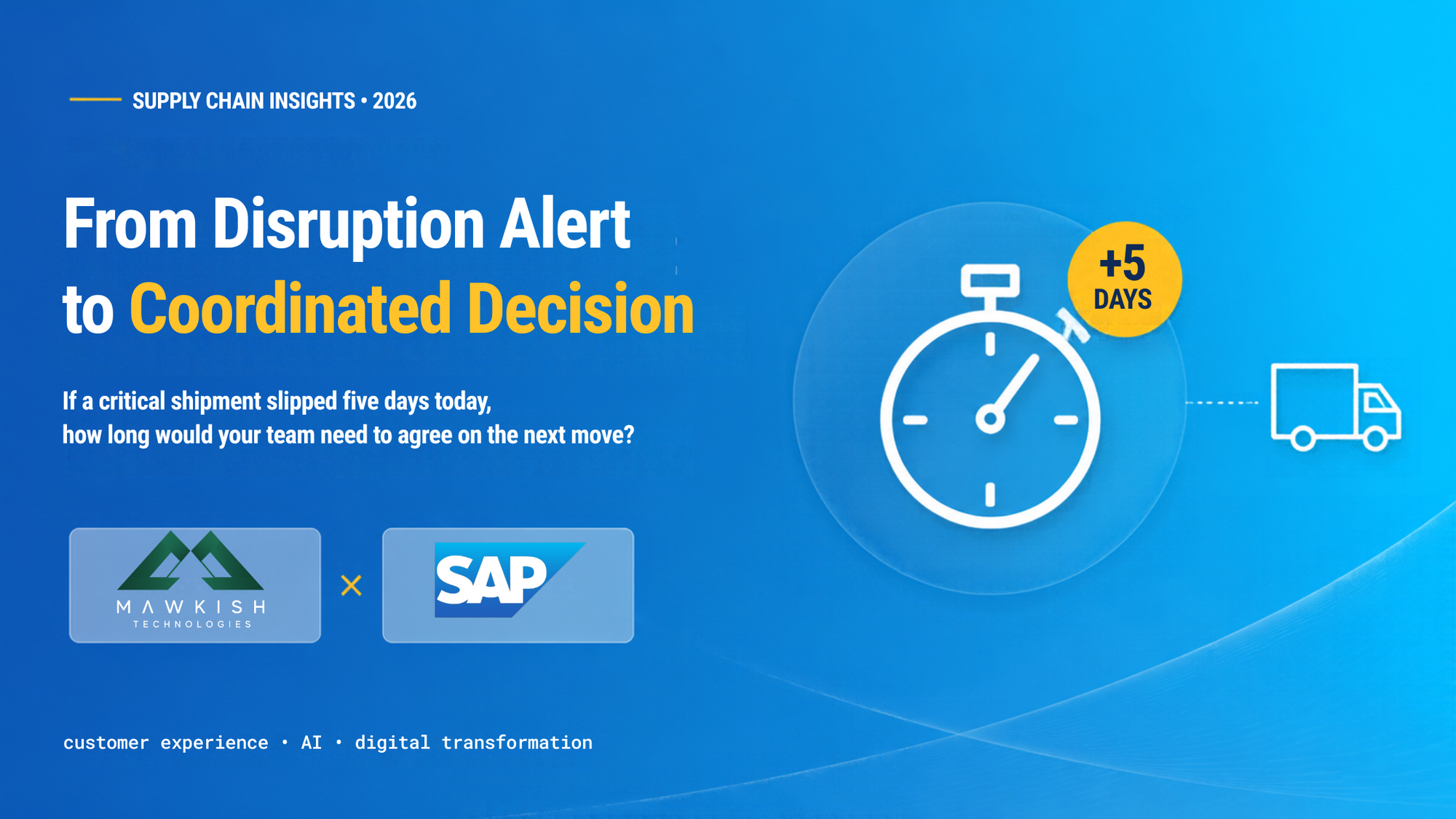
Rather than starting with technology, start with one concrete scenario: a critical raw material is arriving five days late.
In the hours after that alert, can your team quickly establish which production orders are affected? Can they see which customer commitments now need attention, and which customers should hear from you before they hear it from someone else? Can they tell whether an alternative supplier is actually commercially viable, not just available, once price, lead time, quality and contract terms are considered? And can finance see what the revised plan means for cash flow, from expedite costs to delayed invoicing?
None of these questions is new. What slows most businesses down is that each one lives with a different team, in a different system, on a different spreadsheet. Production planning knows the orders. Sales knows the customers. Procurement knows the suppliers. Finance knows the cash. The decision only happens once all four have been pulled together, and that is usually where the days disappear.
A useful technology investment should help the people responsible answer those questions together, from the same picture, at the same time.
The business test: measure decision latency
This gives ERP, data and automation projects a clear and practical test. Measure the time between discovering the delay and agreeing on a workable response.
We call this decision latency. The clock starts when the disruption is first visible to anyone in the business. It stops when operations, commercial and finance teams have agreed on a plan they can execute. It is not the time to send an alert, and it is not the time to produce a report. It is the time to reach a decision that people will act on.
Once you are tracking decision latency, look at the outcomes it drives. The first is delivery performance: did faster decisions protect on-time, in-full delivery to the customers who mattered most? The second is emergency purchasing costs: how much was spent on spot buys, premium freight and expediting because decisions came too late for cheaper options? The third is inventory exposure: how much stock or work-in-progress was left stranded, or how much extra safety stock is being held because the business does not trust itself to respond quickly?
Together, these give operations, finance and technology teams a shared improvement target, one that is far more meaningful than “go live on time” or “number of dashboards delivered.”
What this means for ERP, data and automation projects
If decision latency is the goal, it changes how you scope technology work.
Data comes first. No agent, dashboard or workflow can answer the four questions above if production orders, customer commitments, supplier options and cash positions are not connected. Before investing in more automation, check whether the data needed for a single coordinated view actually exists and can be trusted.
Automation should shorten the path to a decision, not replace it. The most valuable automation in this scenario is the kind that finds the affected orders instantly, simulates the alternatives and puts the trade-offs in front of the right people. That removes hours of manual digging without removing human judgment.
Be deliberate about what AI is allowed to do. Not every response should be handed to an agent. Rescheduling a production sequence is very different from switching suppliers or changing a customer commitment. It is notable that SAP’s own descriptions give agents more room to act in manufacturing and logistics than in supplier decisions. As we have written before, access, limits and human approval belong in your AI project scope from day one, not as an afterthought.
How to get started
You do not need a new platform to begin. Pick one real disruption from the last six months, such as a late shipment, a supplier shortfall or a quality hold, and reconstruct the timeline. When did someone first know? Who did they tell? What information did each team have to go and find? When was the decision actually made, and when was it acted on?
Most businesses that do this exercise find that the delay is not in the analysis itself but in the waiting: waiting for data, waiting for the right people, waiting for approval. That is where technology can make the biggest difference, and it gives you a baseline to measure every future improvement against.
The question worth asking
Disruption is not going away. The businesses that handle it best will not be the ones with the most alerts. They will be the ones that turn those alerts into coordinated decisions fastest.
So here is the question we would put to any operations, finance or technology leader: if a critical shipment slipped today, how long would your business need to agree on the next move?
If you are not sure, or the honest answer is “longer than it should,” that is a good place to start. At Mawkish Technologies, we help organizations connect the data, workflows and AI capabilities that turn disruption signals into confident decisions. Get in touch to talk about where your decision latency is today and how to bring it down.