










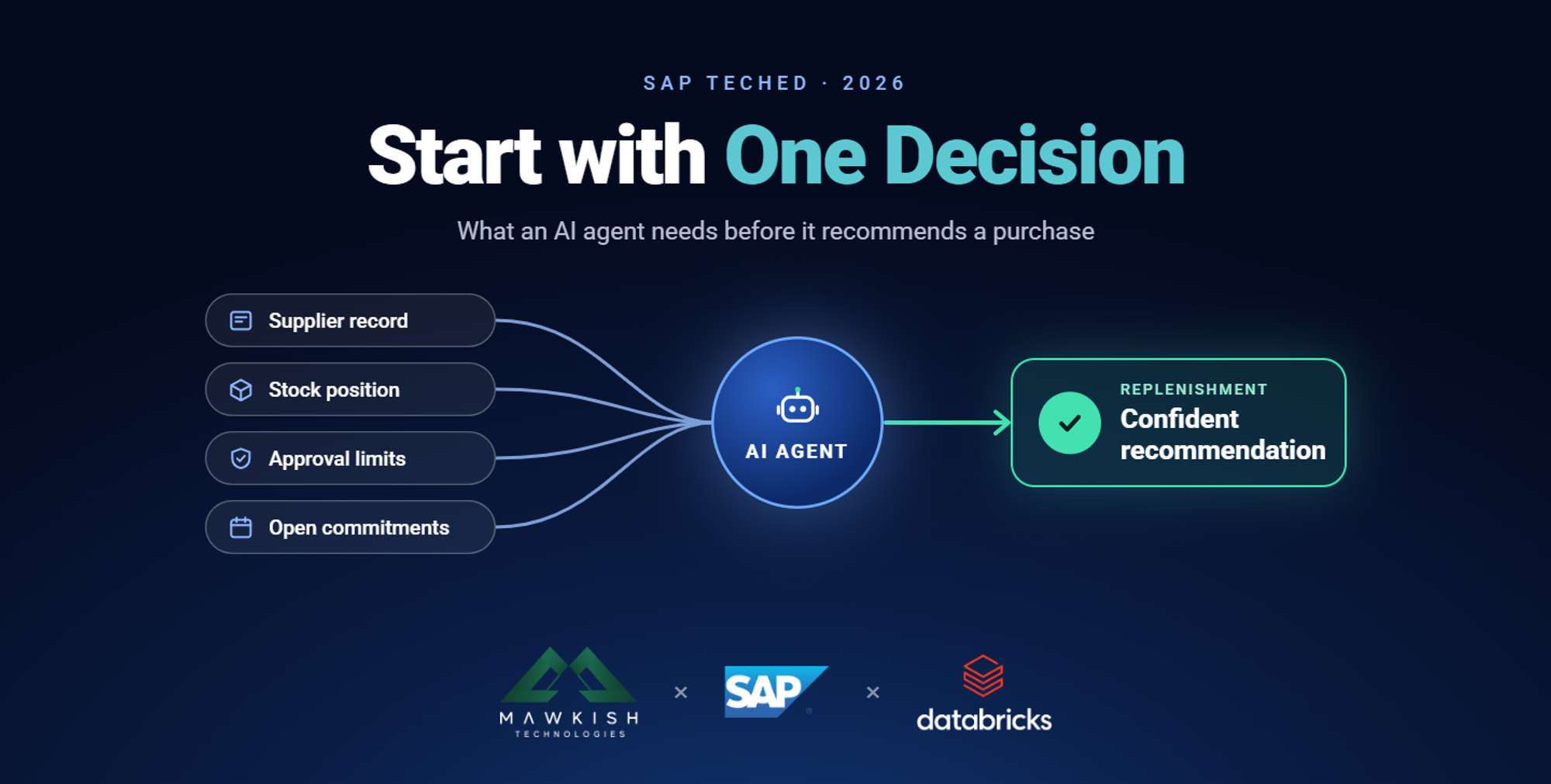
An AI agent handling a purchase request needs to understand more than the request itself. To make a sensible recommendation, it needs the supplier record, the current stock position, the approval limits and the commitments the business has already made.
SAP’s announcements at TechEd this week make that dependency clearer than ever. The real question for most organisations is no longer whether AI agents can work inside business processes. It is whether those agents have the right business context, and whether the business has decided how they should use it.
What SAP announced at TechEd
On 27 October 2026, at SAP TechEd in Berlin, SAP announced a broad set of updates for building and governing AI agents. One of the headline items was an expanded partnership with Databricks. SAP says it will bring more of Databricks’ data engineering and enterprise AI capabilities into SAP Business Data Cloud as SAP Databricks, including Agent Bricks, Lakeflow and Lakebase.
Alongside this, SAP outlined new agent capabilities in Joule. It also described plans to extend SAP Knowledge Graph with data from additional SAP and non-SAP sources, and to bring master data management for customer, supplier and product records into SAP Business Data Cloud. On the governance side, it introduced a planned Enterprise AI Gateway to manage authentication, policy enforcement, monitoring and auditing for AI traffic.
The common thread is business context. An agent is only as useful as the data, rules and relationships it can rely on.
Start with one decision and work backwards
With so much on offer, it is tempting to start with the technology. We think the more practical starting point is a single business decision. Choose one decision that matters, then work backwards to what an agent would need in order to support it well.
Replenishment is a good example. It happens often, it has a clear outcome, and getting it wrong is costly in both directions: too little stock disrupts operations, while too much ties up cash.
Three things to agree before an agent recommends a purchase
Before allowing an agent to recommend a purchase, we would want the team to agree on three things.
Which inventory and demand records should it trust? Most organisations have more than one version of the truth. Stock levels may differ between warehouse and finance systems, and demand signals may come from forecasts, open sales orders or historical usage. Decide which sources the agent should rely on, and what it should do when they disagree.
How should supplier lead times and existing orders affect the recommendation? A purchase recommendation that ignores what is already on order, or how long a supplier really takes to deliver, will create more work than it saves. Agree how lead times are measured and kept up to date, and how open purchase orders are taken into account.
Who approves exceptions or commitments above an agreed limit? Not every recommendation should go straight through. Define the limits within which an agent can act, and name the people who review anything outside them, such as unusual quantities, new suppliers or spend above a set threshold.
These conversations often reveal gaps that have nothing to do with AI: unclear ownership, outdated supplier data, or approval rules that exist only in people’s heads. Resolving them first gives any agent a much firmer foundation.
Test against real scenarios
Once the decision is defined, test the agent’s recommendations against real scenarios, not just the ideal case. Include situations where the data is incomplete, where a supplier is late, or where priorities conflict, such as a cost target pulling against a service-level commitment.
This shows how the agent behaves when things are messy, which is when the business needs it most. It also builds the confidence people need before they rely on its recommendations day to day.
Measure what changes
To understand whether the agent is adding value, we suggest tracking a few simple measures:
Planning time: how long it takes to move from a replenishment need to an approved purchase.
Exception rates: how often recommendations need manual review or correction.
Purchasing accuracy: whether the business is ordering the right quantities, from the right suppliers, at the right time.
Measure these before you introduce the agent, then again afterwards. The difference is the clearest evidence of what it has delivered.
It is also worth checking the availability of each capability you are considering. Several of the TechEd announcements are described as planned or in early access, so confirm what is generally available today before building a plan around it.
Connected systems create the opportunity
In our view, connecting systems creates the opportunity, but it does not guarantee the outcome. Clear ownership and well-defined decisions are what allow a business to use AI agents with confidence.
At Mawkish Technologies, we help organisations take that practical first step. We identify the decisions worth automating, map the data and approvals behind them, and connect SAP and the wider technology landscape so agents can work with reliable business context.